The call usually comes from a property manager in Mason or Loveland, and it usually starts the same way. The entrance bed was replanted in spring. By midsummer the daylilies are chewed to stubs, the hostas by the clubhouse are gone, and three homeowners have emailed the board about it.
Deer damage on a shared property is a different problem from deer damage in a single back yard, and not because the deer behave differently. It is because of what gets planted, where it gets planted, and who has to answer for it.
Deer repellent for an HOA or commercial landscape is a scheduled spraying program applied across the property's planting areas on a set rotation, rather than a one-time treatment. It protects entrance beds, foundation plantings and new installs through the seasons when browsing pressure is highest, so damage is prevented instead of replaced.
Why do deer hit common areas harder than private yards?
Common areas usually contain the cover deer live in and the plantings they prefer, side by side. Wood lines, detention basins, retention ponds and unmown buffer strips give them bedding and travel routes, and the maintained beds sit a short walk away. On most properties the deer are residents, not visitors.
In a subdivision the common ground is often the leftover land: the strip along the creek, the slope behind the pond, the wooded buffer between the development and the road. That land was kept precisely because it was hard to build on, and it is excellent deer habitat.
So the herd is not coming in from somewhere else at dusk. It is already on the property, moving between cover and food on routes it uses every day. The beds at the entrance and around the clubhouse are simply the closest and most palatable thing on that route.
There is a second factor that has nothing to do with the deer. Shared properties get planted with a small number of species in large masses, because that is how good commercial landscape design works. Mass plantings look sharp and they are easy to maintain. They also mean that when the one species in that mass happens to be a deer favourite, the entire bed goes at once rather than a plant here and there.
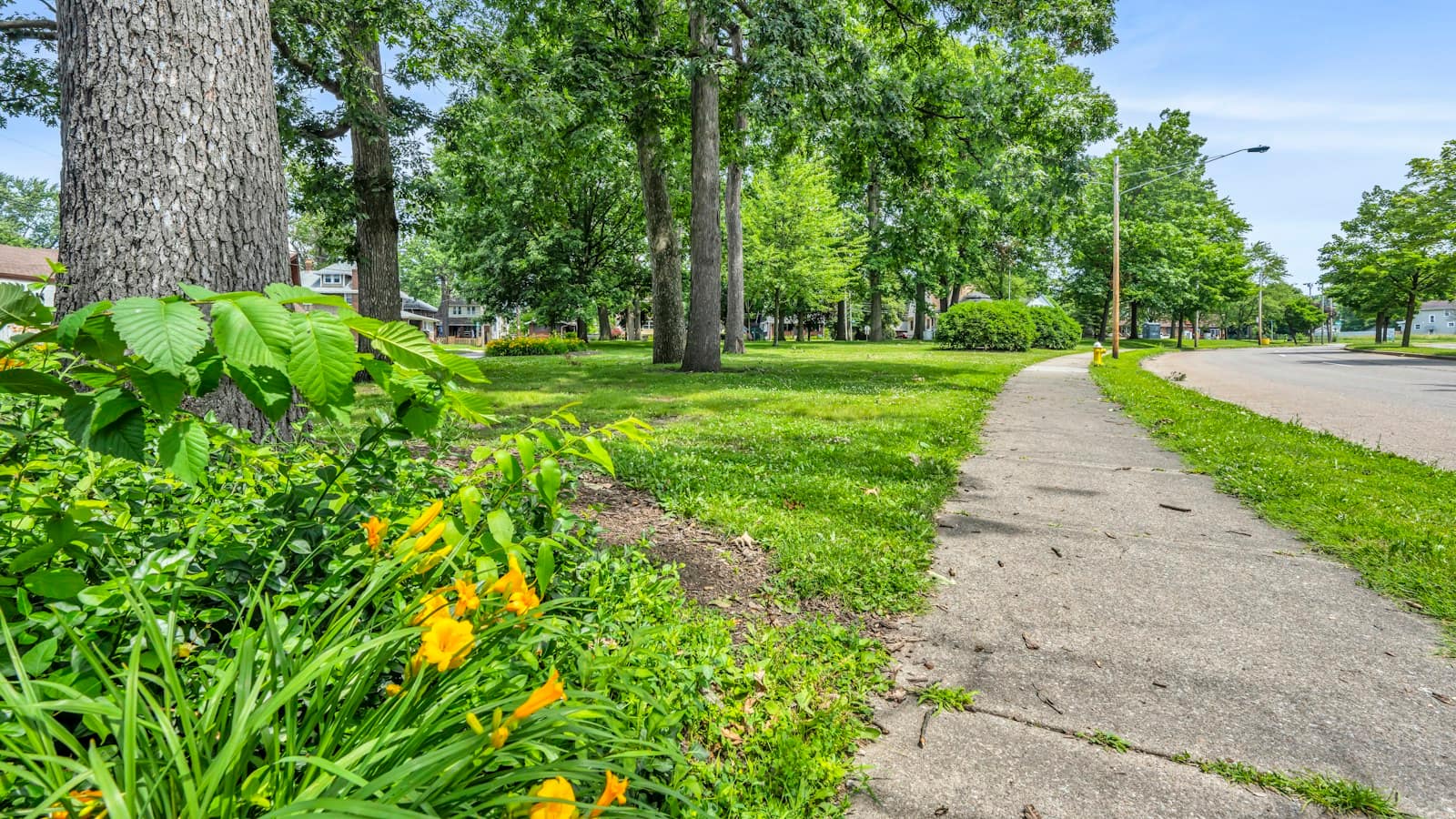
Daylilies are the clearest example around here. They are durable, cheap, spread well and look good in a long drift along a drive, which is why they are everywhere on common ground. They are also one of the plants deer will cross a property to reach.
Which parts of a commercial property take the damage first?
The edges nearest cover take the earliest damage, but the complaints come from the visible areas: the entrance monument bed, the plantings along the main drive, foundation shrubs at the front door and anything newly installed. Those are the spots residents, tenants and visitors actually look at every day.
Walk a property that is under pressure and the pattern is usually consistent.
- The entrance. Highest expectation, highest visibility, and usually the most ornamental planting on the site. Any damage here is the damage that generates the email.
- Beds backing onto cover. The bed along the wood line or above the basin is where browsing starts, often weeks before anyone notices the entrance.
- Foundation plantings at building corners. Deer move along buildings the way they move along any edge, and corner plantings are a natural stopping point.
- This year’s installs. Whatever went in most recently, wherever it went in.
- Irrigated beds in a dry stretch. In a dry summer the irrigated planting on a commercial site can be the softest green thing for a long way.
Knowing the order matters, because it tells you where protection has to start. Treating only the entrance moves the problem rather than solving it. The deer were never eating at the entrance first.
Why does replanting on its own keep failing?
Because replacement plants are more attractive than what they replace. Nursery stock arrives tender, heavily fertilised and well watered, and it goes into the same spot on the same deer route. Without a change in protection, a replanted bed is a fresh meal delivered to a known address.
This is the budget conversation worth having with a board or an owner early, because the arithmetic is usually worse than anyone has added up.
A property that replaces the same entrance bed twice a season is paying for plants, labour, mulch and the staff time to arrange it, every time, with no change in outcome. The plants are not failing. The siting is not failing. Nothing on the property has changed except that the deer learned where the food is, which they learn quickly and do not forget.
Switching the whole planting palette to deer-resistant species is the other instinct, and it helps more than replanting does, but it has limits worth being straight about. Resistant does not mean untouched. Under heavy pressure, particularly late winter when little else is available, deer will eat plants they normally pass by. Our guide to deer resistant plants for Cincinnati gardens covers which ones genuinely hold up here and where that approach runs out.
The approach that changes the outcome is protecting what is planted, on a schedule, so the pressure meets a treated plant rather than an untreated one.
How does a scheduled repellent program work on a large property?
We walk the property first and map which areas take the pressure and where the deer enter. Then applications run on a rotation across those areas through the season, timed to seasonal pressure and plant growth rather than to complaints, and adjusted as new plantings go in or damage patterns move.
The site walk is the part that matters most, and it is the part a generic treatment skips. Two properties a mile apart can need completely different coverage depending on where the cover sits and how the beds relate to it.
What we are looking for is straightforward: where the deer bed, where they travel, which beds sit on those routes, what is planted in them, and which areas the property most needs to look right. That produces a map of what gets treated and how often, instead of an even coat of everything.
From there the work is routine, which is the point. Applications run on a schedule, so protection is in place before the seasons when pressure climbs, in particular late fall through winter when natural food runs out and evergreen and woody plantings take the hit. Our guide to why deer hit Cincinnati yards hardest in fall explains that seasonal swing in more detail, and it applies on commercial ground exactly as it does at a house.
Coverage changes through the year as well. A property with a spring install has a different priority list from the same property in January, when the concern is the arborvitae screen along the parking lot rather than the annual beds.
One practical note for shared properties. We coordinate timing with whoever manages the site, because common areas are in use. The repellent we apply is safe for people, pets, and plants when used as directed, and people and pets should stay off treated areas until dry, which is easy to schedule around on a property where somebody controls the calendar.
What should a board or property manager ask before signing anything?
Ask whether the property gets walked before a plan is written, which specific areas are covered and how often, how new plantings get added mid-season, and what the provider does and does not claim. Anyone promising to remove your deer problem permanently is describing something repellent does not do.
Four questions sort most of it out.
- Is there a site walk, and does the plan name specific areas? A plan that says “the property” without naming beds has not been written from the ground.
- What is the rotation, and does it change by season? Deer pressure is not constant, so a schedule that never changes is not responding to the actual problem.
- What happens when new plants go in? Installs are the highest risk moment on any property and should be covered from day one, not at the next scheduled visit.
- What is actually being claimed? We are a repellent service. We are not an exterminator and we do not remove, trap or harm wildlife. Repellent is a deterrent, and results vary with deer pressure, weather, plant growth and application schedule. Any provider telling a board something stronger than that is setting up a conversation nobody wants to have later.
It is also worth being honest about when this is not the right spend. A property with a small amount of damage in one back corner that nobody sees does not need a full program. A property losing its entrance planting twice a year, or watching an arborvitae screen thin out along a parking lot, is already paying more than the protection costs.
Getting a plan for your property
Deer on shared ground are a maintenance problem rather than an emergency, which is exactly why they tend to get handled one replanting at a time until somebody adds up the year.
We protect HOA common areas, office and retail landscapes, and larger properties across Greater Cincinnati, Southwest Ohio and Northern Kentucky, including Mason, Loveland, Milford, Blue Ash, Montgomery, Anderson Township and the surrounding Clermont, Hamilton and Warren county communities, with the same deer repellent spraying in Cincinnati we run for homeowners. You can see how we handle larger sites on our commercial property protection page, and our deer repellent service page covers the treatment itself. Properties with acreage, pasture or crop ground are a different situation again, and that is covered under rural and farm protection.
If your board or your owner is tired of buying the same plants twice, request a free property estimate. We will walk the site, show you where the pressure is actually coming from, and tell you plainly what a program would cover.
Frequently Asked Questions
How is a commercial deer repellent program different from residential service?
The work is the same, the scale and the scheduling are not. A commercial or HOA property usually has several separate planting areas, a longer route for the technician, and far more edge where deer enter. We walk the property first, identify which areas actually take the pressure, and build a rotation that covers them on a schedule rather than treating everything identically.
Who normally arranges this, the HOA board or the landscape contractor?
Either, and sometimes both together. Plenty of boards call us directly after a season of replacement costs. Just as often the landscape maintenance contractor brings us in because they are tired of installing the same plants twice a year. We are a repellent service, so we work alongside whoever maintains the property rather than replacing them.
Will repellent protect new plantings on a commercial site?
New plantings are the main reason properties call. Fresh installs are tender, well watered and usually sited right where deer already travel, which makes them the first thing browsed. Protection should start at installation rather than after the first damage, because the growth a deer removes from a young plant is gone for that season.
Is the repellent safe for residents, visitors and pets on a common area?
The repellent we apply is safe for people, pets, and plants when used as directed. Keep people and pets away from treated areas until dry. On shared properties we coordinate timing with the property manager so treated areas are not being used while they dry.
How quickly will the board see a difference?
Most properties see browsing drop off on treated areas within the first few applications, but the honest answer is that it depends on how much pressure the site is under and what else is available to the deer nearby. Results vary with deer pressure, weather, plant growth and application schedule, which is why the program runs on a rotation rather than as a one-off visit.
Header photo by Josh Lemmon on Unsplash